Garriga-Canut M, Cannon N, Benton M, Zanon A, Horsfield ST, Scheurich J, Remans K, Lees J, Paix A, van Gestel J. 2026. Unlocking CRISPR-Cas9 editing for widely diverse Dictyostelid species. Mol Syst Biol. 22(4):599-619.
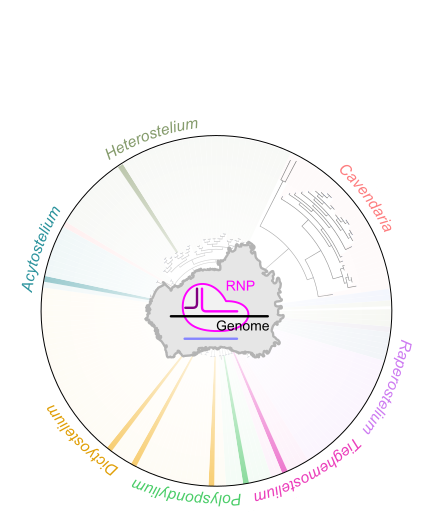
Dictyostelids are a species-rich clade of cellular slime molds that are widely found in soils and have been studied for over a century. Due to a lack of genome editing methods, most molecular research in Dictyostelids has focused on only a single species, Dictyostelium discoideum, which has severely limited broad-scale comparative analyses. Here, we introduce the first CRISPR-Cas9 editing approach that is cloning-free, selection-free, highly efficient, and effective across Dictyostelid species that diverged millions of years ago. Depending on the CRISPR-Cas9 target site, our editing approach generates knock-out efficiencies of up to 90% and knock-in efficiencies of up to 50% without a selective marker. We show that mutants can be isolated as soon as one day post-transfection, vastly outpacing existing methods for generating knock-outs, fusion proteins, and expression reporters. Leveraging single-cell sorting and fluorescent microscopy, we could readily apply our CRISPR-Cas9 editing approach to phylogenetically distant Dictyostelid species, including those that have never been genome edited before. Our methods therefore open the door to performing broad-scale genetic interrogations across the Dictyostelids.
Garriga-Canut M, Cannon N, Benton M, Zanon A, Horsfield ST, Scheurich J, Remans K, Lees J, Paix A, van Gestel J. 2025. Selection-free CRISPR-Cas9 editing protocol for distant Dictyostelid species. bioRxiv. 10.1101/2025.03.23.644600
Koo BM, Todor H, Sun J, van Gestel J, Hawkins JS, Hearne CC, Banta AB, Huang KC, Peters JM, Gross CA. 2025.
Comprehensive genetic interaction analysis of the Bacillus subtilis envelope using double-CRISPRi. Cell Syst. 16(11):101406.van Gestel J, Koo BM, Stürmer VS, Garriga-Canut M, Wagner J, Zanon A, Gross CA. 2025. Bacillus subtilis in defense mode: Switch-like adaptations to protistan predation. Proc Natl Acad Sci U S A. 122(39):e2518989122.
Sanchis Pla L, van Gestel J. 2024. Exploring the microbial savanna: predator-prey interactions in the soil. Molecular Systems Biology. 20(5): 477-480.
Soils host complex multi-trophic communities with diverse, mostly microbial, predator and prey species, including numerous bacterivorous protists and bacterial prey. The molecular mechanisms underlying microbial predator-prey interactions have thus far mainly been explored using reductionist methods, outside the soil environment and independent from the broader life history strategies that microbes display in soils. In this Comment, we advocate for an integrative research approach, combining molecular systems biology and microbial ecology, to investigate how predator-prey interactions shape microbial life history strategies and thereby population dynamics in natural soil communities.

van Gestel J, Wagner A & Ackermann M. 2023. Pleiotropic hubs drive bacterial surface competition through parallel changes in colony composition and expansion. PLoS Biol, 21:e3002338
Gerhardt LMS, Koppitch K, van Gestel J, Guo J, Cho S, Wu H, Kirita Y, Humphreys BD, McMahon AP. 2023. Lineage tracing and single-nucleus multiomics reveal novel features of adaptive and maladaptive repair after acute kidney injury. JASN, 10.1681.
Hölscher, T, van Gestel J, Kovács AT. 2022. Complex extracellular biology drives surface competition in Bacillus subtilis. ISME J, 16(10):2320-2328
Staps M, van Gestel J, Tarnita CE. 2021 Life cycles as a central organizing theme for studying multicellularity. Book chapter in “The evolution of multicellularity” of CRC Press.
van Gestel J, Wagner A. 2021. Cryptic surface-associated multicellularity emerges through cell adhesion and its regulation. PLoS Biol, 19:e3001250
van Gestel J, Hawkins JS, Todor H, Gross CA. 2021. Computational pipeline for designing guide RNAs for mismatch-CRISPRi. STAR protocols, 2: 100521
van Gestel J, Bareia T, Tenennbaum B, Dal Co A, Guler P, Aframian N, Puyesky S, Grinberg I, D'Souza GG, Erez Z, Ackermann M, Eldar A. 2021. Short-range quorum sensing controls horizontal gene transfer at micron scale in bacterial communities. Nature Commun, 12: 2324
Hernandez-Valdes JA, van Gestel J, Kuipers OP. 2020. A riboswitch gives rise to multi-generational phenotypic heterogeneity in an auxotrophic bacterium. Nature Commun, 11(1):1203
van Gestel J. 2020 Slow lane to collectivity. Nature Ecology & Evolution, 4: 292-293
van Gestel J, Ackermann M, Wagner A. 2019. Microbial life cycles link global modularity in regulation to mosaic evolution. Nature Ecology & Evolution, 3: 1184–1196
Staps M, van Gestel J, Tarnita CE. 2019. Emergence of diverse life cycles and life histories at the origin of multicellularity. Nature Ecology & Evolution, 3: 1197–1205.
van Gestel J, Kolter R 2019. When we stop thinking about microbes as cells. Journal of molecular biology, 431:2487-2492
Ramos Y, Rocha J, Hael AL, van Gestel J, Vlamakis H, Cywes-Bentley C, Cubillos-Ruiz JR, Pier GB, Gilmore MS, Kolter R, Morales DK. 2019 PolyGlcNAc-containing exopolymers enable surface penetration by non-motile Enterococcus faecalis. PLoS Pathog, 15:e1007571
van Gestel J, Weissing FJ. 2018. Is plasticity caused by single genes? Nature, 555: E19-E20
van Gestel J, Tarnita CE. 2017. On the origin of biological construction, with a focus on multicellularity. PNAS 114: 11018–11026
van Gestel J, Nowak MA. 2016. Phenotypic heterogeneity and the evolution of bacterial life cycles. PLoS Comput Biol 12: e1004764
van Gestel J, Weissing FJ. 2016. Regulatory mechanisms link phenotypic plasticity to evolvability. Scientific reports, 6: 24524
van Gestel J, Vlamakis H, Kolter R. 2015 From cell differentiation to cell collectives: Bacillus subtilis uses division of labor to migrate. PLoS Biol 13: e1002141
van Gestel J, Vlamakis H, Kolter R. 2015. New tools for comparing microscopy images: a quantitative analysis of cell types in Bacillus subtilis. Journal of Bacteriology 197: 699-709
van Gestel J, Vlamakis HC, Kolter R. 2015. Division of labor in biofilms: the ecology of cell differentiation. Microbiology Spectrum 3: MB-0002-2014. Book chapter in ‘Microbial Biofilms’ (2nd ed.), eds. Ghannoum M., Parsek M., Whiteley M., Mukherjee P.K., ASM Press, Washington DC, USA
Solopova A, van Gestel J, Weissing FJ, Bachmann H, Teusink B, Kok J, Kuipers OP. 2014. Bet-hedging during bacterial diauxic shift. PNAS, 111: 7427-7432
van Gestel J, Weissing FJ, Kuipers OP, Kovács AT. 2014. Density of founder cells affects spatial pattern formation and cooperation in Bacillus subtilis biofilms. ISME J 8: 2069-2079
van Gestel J, Nowak MA, Tarnita CE. 2012. The evolution of cell-to-cell communication in a sporulating bacterium. PLoS Comput Biol 8: e1002818
Kovács AT, van Gestel J, Kuipers OP. 2012. The protective layer of biofilm: a repellent function for a new class of amphiphilic proteins. Molecular Microbiology 85: 8-11.
Schroeder J, Roodbergen M, van Gestel J, van den Brink V, Groen NM, Gerritsen GJ 2010 Associations in male plumage ornamentation and reproductive parameters in the Icelandic Black-tailed Godwit Limosa limosa islandica. Wader Study Group Bull. 117: 85-90